
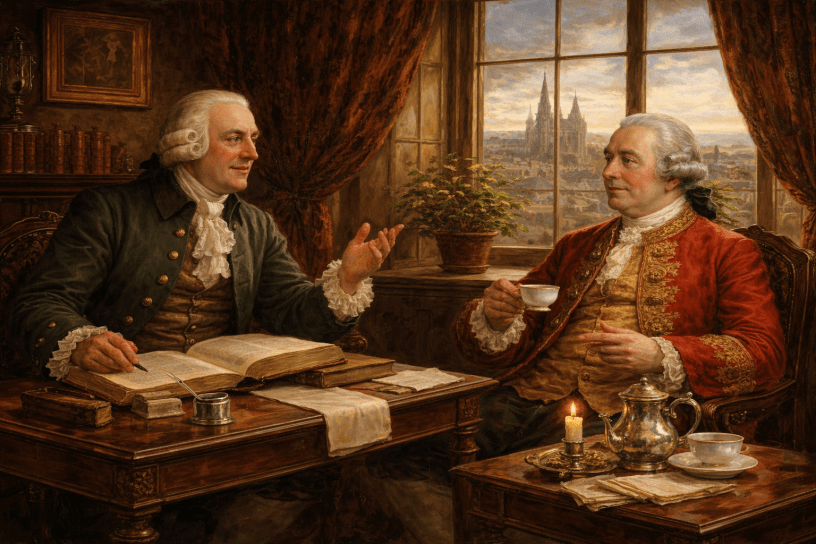
Key similarities and differences in the approaches of Adam Smith and David Hume to political economy.
George Alogoskoufis
Adam Smith and David Hume stand among the intellectual giants of the Scottish Enlightenment, whose inquiries into human nature, society, and political economy laid the groundwork for modern economics and social science. While Smith is often hailed as the “father of economics,” Hume’s writings, especially in political theory and philosophy of commerce, significantly influenced Smith and the broader discipline. Both thinkers shared foundational assumptions about human nature, social order, and the benefits of commerce, but they also diverged in their methods, emphases, and normative conclusions. This essay examines their key similarities and differences regarding political economy, focusing on their views of human motivation, commercial society, money and trade, government’s role, and moral foundations of economic life.
1. Philosophical Foundations and Conception of Human Nature
Both Smith and Hume began their inquiries into political economy by grounding their analysis in a naturalistic understanding of human nature. Hume, especially in his Treatise of Human Nature (1739–40) and Essays, Moral, Political, and Literary (1741–42), argued that humans are governed not by reason alone but by passions and sentiments. He famously wrote, “Reason is, and ought only to be the slave of the passions.” For Hume, self-interest is a powerful driver, but it is moderated by sympathy and social conventions that emerge from repeated interaction.
Smith’s Theory of Moral Sentiments (1759) echoes this view, describing humans as driven by self-love yet equally endowed with a “propensity to sympathize” with others. Thus, both thinkers rejected the rationalistic egoism of earlier philosophers like Hobbes, proposing instead that human beings are sociable creatures whose self-interest is tempered by moral sentiments and social interdependence.
Yet differences exist. Hume viewed the passions as primary and reason as instrumental, whereas Smith placed more weight on the impartial spectator—a quasi-rational faculty through which individuals evaluate their conduct from the perspective of others. This subtle divergence had implications in their respective treatments of moral order in economic life.
2. Origins and Benefits of Commerce
Both Hume and Smith celebrated commercial society as a key driver of prosperity and refinement. Hume argued that commerce promotes industry, innovation, and civilization, famously stating in his essay “Of Commerce” that “It is a violent method, and in most cases impracticable, to attempt to transplant foreign arts into a country… but… the most natural way… is by increasing trade.” He saw commerce as improving manners, fostering peace among nations, and encouraging liberty by dispersing economic power.
Similarly, Smith in The Wealth of Nations (1776) viewed the growth of commerce and the division of labor as the primary engine of wealth. His famous pin-factory example illustrated how specialization magnifies productivity, generating abundance not through state fiat but through voluntary exchange and natural self-interest.
However, Hume was generally more skeptical than Smith about the possibility of universal economic laws. He saw history as contingent, influenced by shifting political regimes and institutional configurations. Smith, while attentive to historical contingency, advanced a more systematic theory of development rooted in universal principles like the propensity to truck, barter, and exchange.
3. Views on Money and Trade
In their analyses of money, trade, and the balance of payments, both Smith and Hume opposed mercantilist orthodoxy, which held that national wealth depended on accumulating precious metals and maintaining a positive trade balance.
Hume’s famous “price-specie-flow mechanism” articulated in his essay “Of the Balance of Trade” (1752) challenged mercantilist doctrines by arguing that trade surpluses would naturally correct themselves. If a country hoarded specie by running a trade surplus, domestic prices would rise, making exports less competitive and imports more attractive, leading eventually to a rebalancing of trade. Thus, he believed government interventions to secure trade surpluses were not only futile but potentially harmful.
Smith built on this idea, systematically demolishing mercantilist fallacies in The Wealth of Nations. He argued that wealth lay not in money but in the productive capacity of a nation—its labor and resources organized through the division of labor and free exchange. Unlike Hume, who often discussed monetary flows in relatively short essays, Smith developed a more comprehensive framework situating trade and money within a broader system of national income and development.
4. Government and Political Institutions
Both men were suspicious of excessive government interference in trade and the economy. Hume criticized government’s tendency toward factionalism, corruption, and waste. In “Of the Independency of Parliament,” he warned about concentrated power and underscored the importance of checks and balances. However, Hume was more comfortable than Smith in granting some discretionary powers to government, especially regarding monetary policy and public credit. He believed government debt could be dangerous but, in certain contexts, unavoidable and even beneficial.
Smith, by contrast, sketched more carefully delineated roles for government: providing defense, justice, and certain public works that private initiative would neglect due to lack of profitability. His night-watchman state was not doctrinaire laissez-faire but rested on the conviction that markets function best when government restrains itself from picking winners or dictating trade flows.
5. Historical Method and Empirical Approach
Another important difference lies in method. Hume generally preferred a broad historical-philosophical approach, illustrating points with examples from classical antiquity or contemporary Europe but avoiding the systematic theorizing found in Smith’s work. Smith combined historical narrative with theoretical abstraction, developing a general theory of economic development tied to stages of society: hunting, pastoral, agricultural, and commercial.
Hume distrusted overly speculative systems, writing that “it is seldom that any lines can be laid down in politics which will not admit of many exceptions.” Smith agreed in principle but sought to identify more universal tendencies in economic behavior and societal evolution.
6. Moral Foundations of Political Economy
Underlying their economic analyses, both thinkers were concerned with the moral health of commercial society. Hume saw commerce as promoting politeness, sociability, and even a greater sense of justice, though he also worried about the corrosive effects of luxury on virtue. Smith was more ambivalent. In The Theory of Moral Sentiments, he recognized that wealth and commerce could breed vanity and undermine civic virtue. Yet he also argued in The Wealth of Nations that the market’s self-regulating nature channeled self-interest into socially beneficial outcomes.
Thus, while both Hume and Smith offered pragmatic defenses of commerce, Smith wrestled more openly with its moral ambiguities, integrating them into a more systematic vision of human flourishing that balanced material progress with moral judgment.
7. Influence and Intellectual Relationship
Smith and Hume were close friends and intellectual collaborators, though Smith was often more optimistic about the potential of rational inquiry to uncover systematic laws. Hume’s skepticism shaped Smith’s sensibilities: Hume urged caution about utopian schemes and reminded Smith that theory should remain grounded in empirical observation.
Smith reciprocated by dedicating The Theory of Moral Sentiments to Hume, calling him “by far the most illustrious philosopher and historian of our age.” Yet despite their friendship, they retained distinctive emphases: Hume the philosopher-skeptic anchoring analysis in passions and historical contingency; Smith the system-builder weaving empirical observation into a coherent theoretical edifice.
8. Legacy and Conclusion
The differences between Hume and Smith highlight the subtle evolution of political economy from philosophical reflection to systematic science. Hume provided the philosophical foundation, challenging mercantilist doctrines and emphasizing the empirical study of history, custom, and human nature. Smith built upon these insights, constructing a broader theory of economic development that married empirical observation with a powerful analytic framework.
Both men shared a belief in the value of commerce, the importance of individual liberty, and the dangers of centralized power. They diverged in their methods—Hume the empiricist essayist, Smith the systematic theorist—and in their assessment of commerce’s moral implications. Together, however, they forged a distinctly Scottish Enlightenment approach to political economy: one skeptical of dogma, grounded in human nature, attuned to history, and optimistic about the power of trade and industry to improve society.
Their combined legacy resonates today, reminding us that political economy is not merely a technical science but a branch of moral philosophy deeply entwined with questions of human nature, justice, and the good society. In examining their similarities and differences, we gain not only historical perspective but also enduring insight into the debates that continue to shape economic thought and policy.
Select Bibliography
- Hume, David. Essays, Moral, Political, and Literary. Ed. Eugene F. Miller. Indianapolis: Liberty Fund, 1987.
- Smith, Adam. An Inquiry into the Nature and Causes of the Wealth of Nations. Ed. R. H. Campbell & A. S. Skinner. Oxford: Oxford University Press, 1976.
- Phillipson, Nicholas. Adam Smith: An Enlightened Life. New Haven: Yale University Press, 2010.
- Berry, Christopher J. Social Theory of the Scottish Enlightenment. Edinburgh: Edinburgh University Press, 1997.
- Haakonssen, Knud (ed.). The Cambridge Companion to Adam Smith. Cambridge: Cambridge University Press, 2006.
 The Ideas of Economists