
George Alogoskoufis
The economic thought of ancient Greece occupies a foundational place in the history of economic ideas. Although the Greeks did not develop economics as a distinct, autonomous discipline—such as it emerged in the 18th century with Adam Smith—they produced a remarkably rich body of reflections on production, exchange, wealth, and the organization of economic life. These reflections were embedded within broader philosophical, ethical, and political inquiries. As a result, Greek economic thought is inseparable from questions about justice, virtue, the good life, and the proper functioning of the polis (city-state).
The contributions of key thinkers such as Hesiod, Xenophon, Plato, Aristotle, and Herodotus reveal a sophisticated understanding of economic processes. While their analyses were not formalized in mathematical terms, they addressed enduring themes: specialization and division of labor, the nature of value and exchange, money and interest, property and inequality, and the relationship between economic activity and moral order.
We examine the economic thought of the ancient Greeks by situating it in its historical context, analyzing the contributions of major thinkers, and assessing its relevance for the evolution of economic theory.
1. Historical and Social Context of Greek Economic Thought
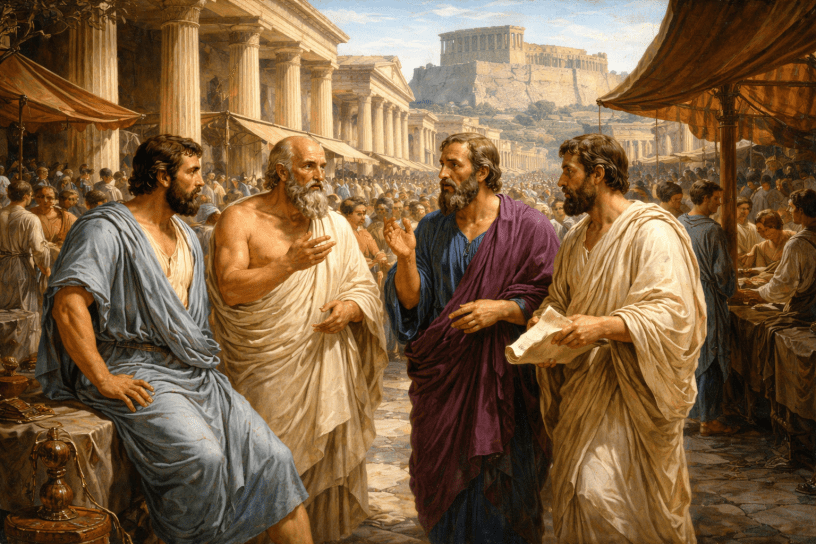
Ancient Greek economic thought must be understood within the institutional framework of the polis, particularly in cities such as Athens during the 5th and 4th centuries BCE. The Greek economy was characterized by:
A predominance of agriculture
The widespread use of slave labor
Limited technological development
Small-scale production and trade
The importance of citizenship and political participation
Economic activity was not viewed as an autonomous sphere governed by its own laws. Instead, it was subordinated to ethical and political considerations. The ultimate goal was not wealth maximization, but the attainment of a good and virtuous life.
The Greeks distinguished between oikonomia (household management) and chrematistics (wealth acquisition). This distinction, most fully articulated by Aristotle, would become central to later debates about the legitimacy and limits of economic activity.
2. Hesiod: The Origins of Economic Thought in Archaic Greece
The poet Hesiod (c. 700 BCE) occupies a distinctive and often underappreciated place in the history of economic thought. Chronologically, he predates Xenophon, Plato, and Aristotle by several centuries, and his perspective reflects an earlier, agrarian society rather than the more complex commercial world of classical Athens.
Yet, in his didactic poem Works and Days, Hesiod offers one of the earliest systematic reflections on economic life in Western thought. His contribution is not analytical in the later philosophical sense, but it is deeply insightful, especially regarding labor, scarcity, justice, and the moral foundations of economic activity.
3. Xenophon: Practical Economics and Household Management
Xenophon (c. 430–354 BCE) is often regarded as the first Greek thinker to provide a systematic treatment of economic issues. His works, particularly Oeconomicus and Poroi (Ways and Means), offer practical insights into household management, agriculture, and public finance.
3.1 Oeconomicus and the Management of the Household
In Oeconomicus, Xenophon presents a dialogue that explores the efficient management of a household estate. Key themes include the importance of organization and supervision, the role of division of labor within the household and the efficient use of resources, especially land and labor
Xenophon emphasizes that economic success depends on knowledge, discipline, and leadership. He also highlights the role of women in managing household affairs, suggesting an early recognition of economic roles beyond formal market activity.
3.2 Division of Labor and Specialization
Xenophon provides one of the earliest discussions of specialization. He observes that in larger cities, individuals specialize in narrower tasks and that specialization leads to higher productivity and better quality
This insight anticipates the more famous analysis of the division of labor by Adam Smith in The Wealth of Nations.
3.3 Public Finance in Poroi
In Poroi, Xenophon addresses the economic challenges of Athens, proposing policies to increase public revenue. These include the development of mining, especially silver mines at Laurion, the promotion of trade and immigration and the efficient management of public assets. His proposals reflect a pragmatic approach to economic policy, grounded in empirical observation.
4. Plato: Economic Organization and the Ideal State
Plato (427–347 BCE) integrates economic ideas into his broader philosophical system, particularly in The Republic and The Laws.
4.1 Division of Labor and the Origin of the Polis
In The Republic, Plato argues that the polis arises from the need to satisfy human wants, as individuals have different natural abilities, specialization increases efficiency and exchange allows individuals to benefit from each other’s skills.
This analysis represents one of the earliest theoretical accounts of the division of labor and the interdependence of economic agents.
4.2 Property, Inequality, and Social Order
Plato is deeply concerned with the destabilizing effects of wealth inequality. In his ideal state, the ruling class holds property in common. For Plato excessive wealth and poverty are both seen as harmful, and therefore he sees economic regulation as necessary to preserve social harmony
In The Laws, Plato adopts a more moderate position, allowing private property but imposing limits on wealth accumulation.
4.3 Critique of Commerce and Money
Plato is skeptical of commercial activity. Trade is considered necessary but morally ambiguous as the pursuit of profit can undermine virtue. Money should serve as a medium of exchange, not an end in itself
This ambivalence reflects a broader Greek suspicion of market-oriented behavior.
5. Aristotle: The Foundations of Economic Analysis
Aristotle (384–322 BCE) provides the most systematic and influential treatment of economic issues in antiquity. His discussions in Politics and Nicomachean Ethics address key economic concepts with remarkable clarity.
5.1 Oikonomia vs. Numismatics
Aristotle distinguishes between Oikonomia, the natural and legitimate management of the household and Numismatics, the art of acquiring wealth, especially through trade and money-making. He considers Oikonomia to be necessary and virtuous, while Numismatics—particularly in its unlimited form—as unnatural and morally suspect.
4.2 Value, Exchange, and Reciprocity
Aristotle develops an early theory of value arguing that exchange requires commensurability between goods. He recognises the role of money as a common measure of value. He argues that justice in exchange involves proportional reciprocity. Although he does not formulate a labor theory of value, Aristotle recognizes that value is socially determined and linked to exchange relations.
4.3 Money and the Critique of Usury
Aristotle offers a sophisticated analysis of money. Money originates as a medium of exchange, it facilitates trade and overcomes the limitations of barter and it serves as a store of value. However, he strongly criticizes usury (interest on loans). He argues that money is ‘sterile’ and should not generate more money. Thus, interest is seen as unnatural and exploitative.
This critique would influence medieval economic thought, particularly in Scholastic theology.
4.4 Private Property and Incentives
Unlike Plato, Aristotle defends private property, as it provides incentives for effort and productivity and promotes responsibility and social stability. However, its use should be guided by moral considerations. Thus, he advocates a balance between individual ownership and communal use.
6. Historians and Economic Observations
Greek historians such as Herodotus and Thucydides also provide valuable insights into economic life.
6.1 Herodotus
Herodotus offers descriptive accounts of trade networks across the Mediterranean and Near East, the economic practices of different cultures and the role of wealth in political power. His work highlights the diversity of economic systems and the importance of geography and institutions.
5.2 Thucydides
Thucydides focuses on the economic dimensions of war. He highlights the importance of financial resources for military power, the role of tribute and taxation in sustaining empires and the economic consequences of conflict.
His analysis anticipates later discussions of political economy and international relations.
7. Key Themes in Greek Economic Thought
A defining feature of Greek economic thought is its integration with ethics. Economic activity is judged by its contribution to the good life. Wealth is considered a means, not an end. In addition, moral considerations are seen as a constraint on economic behavior.
The Greeks generally reject the idea of unlimited wealth. Excessive accumulation is seen as harmful and economic activity as having natural limits. This contrasts with modern capitalist assumptions
While recognizing the necessity of trade, Greek thinkers are wary of markets as profit-seeking can undermine virtue. Commerce is associated with instability and inequality and economic regulation is often advocated.
Despite their ethical orientation, the Greeks provide important analytical insights on the division of labor and specialization, the role of money and the importance of incentives and institutions
7. Influence on Later Economic Thought
Greek economic thought had a profound impact on subsequent intellectual traditions. Medieval Scholastics adopted Aristotle’s views on money and usury. Renaissance humanists revisited classical ideas about civic life, and early modern economists engaged with Greek concepts, directly or indirectly. The distinction between use value and exchange value, the analysis of money, and the emphasis on ethical constraints all resonate in later economic theory.
Conclusion
The economic thought of the ancient Greeks represents a crucial stage in the development of economic ideas. Although it lacks the formal structure of modern economics, it offers deep insights into the nature of economic activity and its relationship to society.
Thinkers such as Xenophon, Plato, and Aristotle grappled with fundamental questions that remain relevant today: What is the purpose of economic activity? How should wealth be distributed? What are the moral limits of markets?
Their answers reflect a worldview in which economics is embedded in ethics and politics. In contrast to modern approaches that emphasize efficiency and growth, the Greeks prioritized balance, moderation, and the pursuit of the good life.
For contemporary economists and historians of thought, the Greek tradition serves as both a foundation and a critique—a reminder that economic systems must ultimately be evaluated in terms of their contribution to human well-being.
 The Ideas of Economists