
George Alogoskoufis
_________________________________________________
The theory of interest occupies a central place in the history of economic thought because it lies at the intersection of capital accumulation, money, banking, saving and investment decisions, inflation, and macroeconomic stability. Between the nineteenth century and the middle of the twentieth century, the theory of interest evolved from a relatively simple classical doctrine concerning thrift and productivity into a sophisticated analysis integrating monetary dynamics, expectations, financial instability, and macroeconomic fluctuations. This transformation reflected broader historical developments: industrialization, the rise of modern banking systems, recurrent financial crises, the expansion of central banking, and ultimately the collapse of the interwar international economy during the Great Depression.
The evolution of interest theory can be understood as a gradual attempt to reconcile two fundamentally different perspectives. One tradition viewed interest as a real phenomenon determined by saving, productivity, and time preference. The other viewed interest as a monetary phenomenon shaped by banking systems, liquidity conditions, and financial behavior. The history of modern macroeconomics largely emerged from efforts to integrate these two approaches.
Among the most important contributors to this evolution were Thomas Tooke, Knut Wicksell, Irving Fisher, John Maynard Keynes, the Austrian School, the pre-Keynesian Cambridge economists, and the Stockholm School. Together they created the foundations of modern monetary economics and macroeconomic theory.
Classical Origins of Interest Theory
The classical economists, especially Adam Smith, David Ricardo, and John Stuart Mill, regarded interest primarily as a real phenomenon arising from the interaction between saving and investment. Interest represented the reward for abstinence from present consumption and the return to productive capital.
In classical theory, flexible interest rates coordinated saving and investment, ensuring equilibrium in capital markets. Money played only a secondary role. Monetary disturbances might temporarily affect economic activity, but in the long run the interest rate reflected real forces:
- thrift,
- capital productivity,
- and capital scarcity.
Yet nineteenth-century industrial capitalism increasingly revealed the limitations of purely real theories. Banking crises, speculative booms, fluctuations in credit, and the growing importance of central banks forced economists to examine the monetary and financial dimensions of interest-rate determination.
Thomas Tooke and the Banking School
Thomas Tooke was one of the leading representatives of the British Banking School during the monetary controversies of nineteenth-century Britain. Opposing the Currency School, which argued that inflation and crises resulted primarily from excessive note issuance, Tooke emphasized endogenous credit creation and the dependence of interest rates on broader commercial conditions.
Tooke rejected the simplistic idea that interest rates were determined directly by the quantity of money. Instead, he argued that rates reflected:
- business conditions,
- profitability,
- trade activity,
- and the demand for credit.
Banks, according to Tooke, largely responded to the “needs of trade.” Credit creation was therefore endogenous rather than mechanically controlled by monetary authorities.
Tooke also provided important insights into financial crises. High interest rates during crises reflected liquidity shortages and collapsing confidence rather than excessive prior monetary expansion alone. In this respect, Tooke introduced a dynamic analysis of banking instability and speculative cycles that anticipated modern financial macroeconomics.
Although Tooke did not formulate a formal equilibrium theory of interest, he established several themes that would profoundly influence later economists:
- the distinction between money and capital markets,
- the endogeneity of credit,
- the importance of banking systems,
- and the interaction between finance and economic fluctuations.
The Austrian School and the Real Theory of Interest
While Tooke emphasized banking and credit, the Austrian School developed a sophisticated theory of the real foundations of interest. Beginning with Carl Menger and especially Eugen von Böhm-Bawerk, Austrian economists focused on time preference, capital structure, and intertemporal coordination.
Böhm-Bawerk argued that interest arises because individuals systematically value present goods more highly than future goods. This became known as the theory of time preference. Present goods command a premium because:
- individuals prefer immediate consumption,
- the future is uncertain,
- and present resources can immediately be used in productive activity.
Interest therefore reflects the discount between present and future goods.
The Austrian School also developed a rich theory of capital. Böhm-Bawerk emphasized “roundabout” production methods: longer and more capital-intensive production processes are often more productive but require deferred consumption and waiting.
Interest rates therefore coordinate:
- saving,
- investment,
- and the temporal structure of production.
Unlike later neoclassical theories that treated capital as homogeneous, Austrian economists emphasized the heterogeneous and time-structured nature of capital goods.
Knut Wicksell and the Natural Rate of Interest
Knut Wicksell synthesized elements of the Banking School and Austrian capital theory into a systematic monetary theory centered on the distinction between the natural rate and the market rate of interest.
The natural rate in referred to the equilibrium real interest rate consistent with equality between saving and investment, and stable prices.
The market rate im was the actual interest rate charged by banks.
Wicksell’s major contribution was his theory of the cumulative process. If the market rate fell below the natural rate,
im<in
investment would exceed saving, aggregate demand would rise, banks would create additional credit, and inflationary pressures would emerge cumulatively.
Conversely, if the market rate exceeded the natural rate,
im>in
saving would exceed investment, aggregate demand would weaken, and deflationary pressures would emerge.
Wicksell thus transformed interest theory into a dynamic theory of monetary disequilibrium. His analysis profoundly influenced:
- the Austrian School,
- the Cambridge economists,
- the Stockholm School,
- Keynes,
- and ultimately modern central banking.
Modern monetary policy remains deeply Wicksellian in its focus on neutral or equilibrium interest rates.
The Loanable-Funds Theory
One of the most important intermediate developments between Wicksell and Keynes was the loanable-funds theory of interest, developed by economists such as:
- Wicksell,
- Dennis Robertson,
- Bertil Ohlin,
- and other Cambridge and Stockholm economists.
According to this theory, interest rates are determined by the supply and demand for loanable funds.
Supply derives from:
- saving,
- bank credit,
- and dishoarding.
Demand derives from:
- investment,
- hoarding,
- and government borrowing.
The loanable-funds framework was important because it integrated real saving-investment forces, with monetary and banking factors.
It therefore represented a synthesis between classical real theories and Banking School monetary theories.
The loanable-funds approach dominated much pre-Keynesian macroeconomics. Keynes later criticized it sharply, arguing that saving adjusts primarily through changes in income rather than through interest-rate movements alone.
Austrian Business Cycle Theory
The Austrian School, particularly through Ludwig von Mises and Friedrich Hayek, extended Wicksell’s analysis into a comprehensive theory of business cycles.
According to Austrian business cycle theory, crises arise when banks or central banks push market interest rates below the natural rate. Artificially cheap credit encourages excessive investment in long-term projects unsupported by genuine saving.
This creates “malinvestment.” Entrepreneurs are misled by distorted interest-rate signals into undertaking unsustainable investment projects. Eventually inflation, rising costs, or tighter monetary policy reveal these inconsistencies, producing recession and liquidation.
In Prices and Production, Hayek emphasized that interest rates coordinate the temporal structure of production. Artificially low rates distort relative prices and encourage excessively “roundabout” production methods.
The Austrian theory therefore integrated:
- Böhm-Bawerk’s capital theory,
- Wicksell’s natural-rate framework,
- and monetary disequilibrium analysis.
The Cambridge School before Keynes
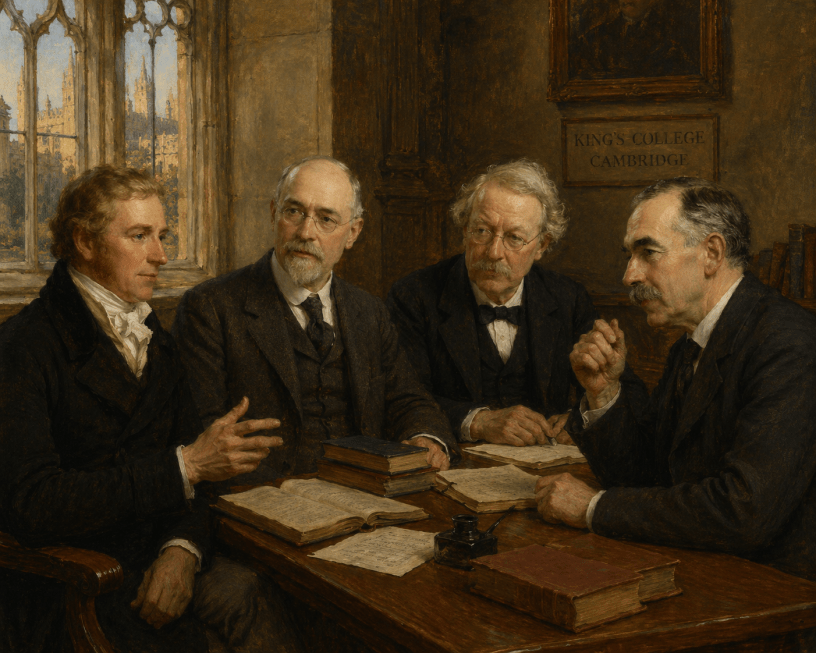
An important transitional stage in interest theory was the Cambridge School associated with the University of Cambridge. Economists such as Alfred Marshall, A. C. Pigou, Dennis Robertson, Ralph Hawtrey, and the early John Maynard Keynes combined classical, Wicksellian, and Banking School ideas.
Marshall still regarded interest as the reward for waiting and the mechanism coordinating saving and investment. Yet Cambridge economists increasingly emphasized:
- money demand,
- liquidity,
- expectations,
- and banking behavior.
One major contribution was the Cambridge cash-balance approach to money demand:
M=kPY
This reformulated monetary theory around desired cash holdings and anticipated Keynesian liquidity preference.
Robertson emphasized monetary disequilibrium and divergences between saving and investment, while Hawtrey extended Tooke’s Banking School tradition by emphasizing bank credit and short-term interest rates in generating business cycles.
The pre-General Theory Keynes himself still operated largely within this Cambridge-Wicksellian framework in the Tract on Monetary Reform and the Treatise on Money.
The Stockholm School
The Stockholm School further developed Wicksellian analysis during the interwar period. Economists such as Gunnar Myrdal, Bertil Ohlin, and Erik Lindahl developed dynamic disequilibrium analysis centered on expectations and the distinction between ex ante and ex post saving and investment.
This distinction became extremely influential. Planned saving and planned investment may diverge ex ante, but ex post accounting identities ensure equality after income adjustments occur.
These ideas strongly influenced Keynesian macroeconomics and later dynamic macroeconomic theory.
Irving Fisher and the Real Rate of Interest
Irving Fisher developed one of the first rigorous modern theories of intertemporal equilibrium. Like the Austrians, Fisher emphasized time preference and investment opportunities, but he formalized these concepts mathematically.
The equilibrium interest rate balances household preferences for present versus future consumption, and firms’ demand for investment.
Fisher’s most famous contribution was the distinction between nominal and real interest rates, based on the Fisher equation that defined the nominal interest rate i as the real interest rate r plus expected inflation πe.
i=r-πe
This Fisher equation fundamentally transformed monetary economics by incorporating inflation expectations into financial markets.
Fisher also remained associated with the quantity theory tradition through the quantity theory equation:
MV=PT
Yet after the Great Depression, Fisher’s debt-deflation theory increasingly emphasized financial instability, excessive debt burdens, and cumulative contraction processes resembling Tooke’s and Wicksell’s concerns.
Keynes and Liquidity Preference
The most revolutionary break with earlier theories came with Keynes’s General Theory of Employment, Interest and Money.
Keynes rejected the classical and loanable-funds view that the interest rate equilibrates saving and investment. Instead:
- investment depends on expectations and profitability,
- saving depends largely on income,
- and interest is fundamentally a monetary phenomenon.
According to Keynes, the interest rate is determined by liquidity preference and the supply of money. Individuals hold money because it provides liquidity under uncertainty.
The demand for money depends partly on speculative motives. When uncertainty rises, individuals prefer liquid money balances rather than bonds or illiquid assets.
The interest rate therefore equilibrates:
- liquidity preference,
- and the money supply.
This was a revolutionary shift from real theories of interest toward a fundamentally monetary and psychological theory centered on uncertainty.
Keynes also introduced the concept of the liquidity trap, where extremely low interest rates render monetary policy ineffective because individuals willingly absorb additional money balances.
The famous Keynes-Hayek debates of the 1930s reflected fundamentally different visions of capitalism, as Austrian economists emphasized intertemporal distortions and malinvestment, and Keynes emphasized uncertainty, insufficient aggregate demand, and macroeconomic instability.
The Neoclassical Synthesis
After World War II, economists such as John Hicks, Paul Samuelson, and Franco Modigliani attempted to synthesize:
- Keynesian macroeconomics,
- Wicksellian interest-rate theory,
- Fisherian intertemporal choice,
- and neoclassical equilibrium analysis.
The IS-LM framework combined:
- liquidity preference,
- loanable-funds theory,
- and income determination.
This synthesis became the foundation of postwar macroeconomics.
Conclusion
The history of interest theory from the nineteenth century to the mid-twentieth century reflects the gradual integration of real capital theory with monetary and financial analysis.
Tooke emphasized banking systems and endogenous credit. The Austrian School developed the real theory of interest through time preference and capital structure. Wicksell integrated monetary and real forces through his distinction between market and natural rates. The loanable-funds theorists synthesized saving-investment and monetary analysis. The Cambridge and Stockholm Schools emphasized money demand, expectations, and disequilibrium dynamics. Fisher formalized intertemporal equilibrium and inflation expectations. Keynes transformed interest theory into a theory of liquidity preference under uncertainty. Finally, the neoclassical synthesis attempted to integrate these traditions into modern macroeconomics.
Modern economics continues to draw heavily on all these approaches. Contemporary central banks remain deeply Wicksellian. Financial markets rely fundamentally on Fisherian distinctions between real and nominal returns. Austrian concerns with credit booms and asset bubbles continue to influence debates on financial instability. Keynesian ideas about liquidity and uncertainty remain central during crises and recessions.
The evolution of interest theory therefore mirrors the broader evolution of economics itself: from classical political economy toward a sophisticated analysis of money, finance, expectations, uncertainty, and macroeconomic stability.
___________________________________________
Select Bibliography
Classical and Banking School
- Adam Smith, An Inquiry into the Nature and Causes of the Wealth of Nations (1776).
- David Ricardo, On the Principles of Political Economy and Taxation (1817).
- John Stuart Mill, Principles of Political Economy (1848).
- Thomas Tooke, An Inquiry into the Currency Principle (1844).
- Tooke, Thomas and William Newmarch, A History of Prices and of the State of the Circulation from 1793 to 1856, 6 vols. (1838–1857).
Austrian School
- Carl Menger, Principles of Economics (1871).
- Eugen von Böhm-Bawerk, Capital and Interest (1884–1889).
- Ludwig von Mises, The Theory of Money and Credit (1912).
- Friedrich Hayek, Prices and Production (1931).
- Hayek, Friedrich, Monetary Theory and the Trade Cycle (1933).
Wicksell and the Stockholm School
- Knut Wicksell, Interest and Prices (1898; English translation 1936).
- Wicksell, Knut, Lectures on Political Economy, Volumes I and II (1901–1906).
- Gunnar Myrdal, Monetary Equilibrium (1939).
- Bertil Ohlin, “Some Notes on the Stockholm Theory of Savings and Investment I & II,” Economic Journal (1937).
- Erik Lindahl, Studies in the Theory of Money and Capital (1939).
Cambridge School
- Alfred Marshall, Principles of Economics (1890).
- Marshall, Alfred, Money, Credit and Commerce (1923).
- A. C. Pigou, Industrial Fluctuations (1927).
- Dennis Robertson, Banking Policy and the Price Level (1926).
- Ralph Hawtrey, Currency and Credit (1919).
- John Maynard Keynes, A Treatise on Money, 2 vols. (1930).
Irving Fisher
- Irving Fisher, The Rate of Interest (1907).
- Fisher, Irving, The Purchasing Power of Money (1911).
- Fisher, Irving, The Theory of Interest (1930).
- Fisher, Irving, “The Debt-Deflation Theory of Great Depressions,” Econometrica (1933).
Keynes and Keynesian Economics
- John Maynard Keynes, The General Theory of Employment, Interest and Money (1936).
- Keynes, John Maynard, Essays in Persuasion (1931).
- Keynes, John Maynard, Essays in Biography (1933).
Neoclassical Synthesis and Early Postwar Macroeconomics
- John Hicks, “Mr. Keynes and the ‘Classics’: A Suggested Interpretation,” Econometrica (1937).
- Paul Samuelson, Foundations of Economic Analysis (1947).
- Franco Modigliani, “Liquidity Preference and the Theory of Interest and Money,” Econometrica (1944).
Important Secondary References
- Mark Blaug, Economic Theory in Retrospect (multiple editions).
- Joseph Schumpeter, History of Economic Analysis (1954).
- Don Patinkin, Money, Interest and Prices (1956).
- Axel Leijonhufvud, On Keynesian Economics and the Economics of Keynes (1968).
- Robert Skidelsky, John Maynard Keynes, 3 vols. (1983–2000).
- Friedrich Hayek, The Pure Theory of Capital (1941).
- Bertil Ohlin, Interregional and International Trade (1933), especially methodological discussions of equilibrium and capital.
- Murray Rothbard, Man, Economy, and State (1962), for the Austrian interpretation of interest theory.
- Michael Woodford, Interest and Prices: Foundations of a Theory of Monetary Policy (2003), for the modern Wicksellian revival.

